Artificial glaciers hydrating some of earth’s driest places
Researchers are enhancing an innovation that is providing vital water in some of the most arid places on the planet.
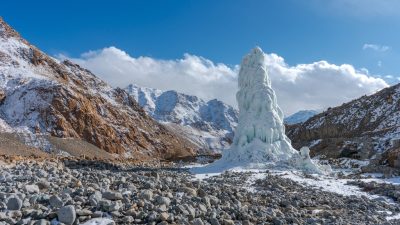
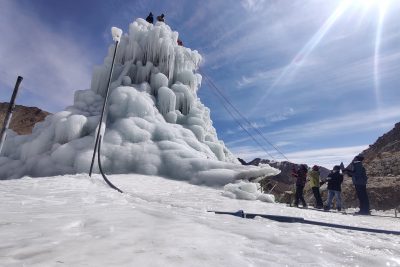
Ice stupas are artificial glaciers used for storing winter water for use in the arid months when meltwater is scarce. Invented by engineer Sinam Wangchuk in Ladakh, India, in 2013, they can release millions of litres of water each year.
Shrinking glaciers combined with drier winters, as a result of climate change, have led to frequent and extended droughts, which are now threatening the life-sustaining crops that are cultivated by rural communities in some of the coldest and driest parts of the world.
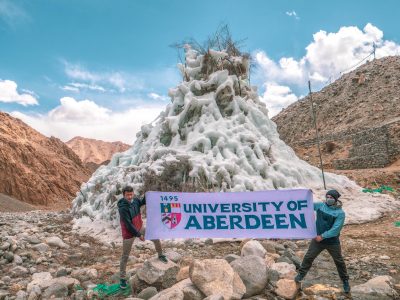
The Cryosphere and Climate Change research group of the University of Aberdeen, Scotland, in collaboration with the Jawaharlal Nehru University in New Delhi, has shown that ‘glacier shrinkage’ in Ladakh, northern India, has increased at a dramatic pace over the last two decades. For Ladakh, a ‘cold desert’ with very little precipitations, the ice stupas have become a lifeline – providing essential meltwater to extend the otherwise very limited crop growing season by several weeks.
The ice stupa concept is not new and could be linked to the ancient, fascinating practice of ‘glacier grafting’ and, more recently, the building of ‘artificial glaciers’, which typically occur at high elevations, far from villages and hence difficult to maintain. The ice stupas are instead built next to where the water is needed most, right on the outskirts of villages, near their fields. The size and shape of ice stupas make them particularly efficient, inexpensive and easy to maintain.
The project is still in its infancy, with work continuing on technical aspects, such as ways to avoid water freezing in the pipelines and site selection, and gaining a better understanding of local micro-climates and improved distribution of water across multiple users and villages.
The University of Aberdeen, funded by the Scottish Funding Council, is working to establish a long-lasting collaboration with the local ice stupa team and academic colleagues in India to provide some of the answers to these questions.
Professor Matteo Spagnolo, of the University of Aberdeen’s Cryosphere and Climate Change Research Group, said: “Glaciers are exceptionally good and reliable indicators of climate change. Put in the simplest terms, as temperatures rise, glaciers shrink and may eventually disappear. As well as being photogenic, spectacular emblems of climate change, glaciers are also, for many communities, an irreplaceable source of fresh water.
“Our research has shown that mountain glaciers in Ladakh are retreating at an increasing rate, and so it is clear that interventions such as ice stupas are essential.”
Dr Anshuman Bhardwaj, also from the University of Aberdeen team, added: “We are working closely with our partners in the Ice Stupa Project team to help with some of the aspects of the technical and logistical challenges and also looking to better understand the rate of glacier retreat and how this can inform our strategy going forward.”
"Glaciers are, for many, an irreplaceable source of fresh water"