
Can we prevent another Titanic? Ask Knut
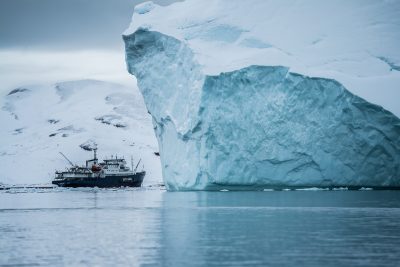
A new app that can classify different kinds of ice at sea could help prevent Titanic-scale disasters in the future. Ask Knut is under development at the Norwegian University of Science & Technology (NTNU) in Trondheim. It uses deep learning and artificial intelligence (AI) to map different types of ice in record time.
Sea ice forms, grows and melts in the ocean – it is distinct from icebergs and glaciers which float in the ocean but originate on land. The Arctic boasts hundreds of different types of ice formation, each with its own characteristics and designation.
Ekaterina Kim, a marine scientist at the Norwegian University of Science & Technology, said, “A photo of an ice sheet actually reveals quite a lot. Among other things, it can tell you what time of year the photo was taken, and the condition and thickness of the ice, which tells you something about what type of ice it is. The colour, for example, indicates how old or new the ice is.”
She says there are hundreds of descriptive names for types of ice and each relates to the conditions under which the ice was formed. These include pancake ice, pinnacled iceberg, brash ice, sloping iceberg, dirty ice and frost flowers.
The researchers’ goal for Ask Knut is to develop a system people on board vessels can use to discover and identify different types of floating ice to prevent accidents and injuries. Identifying different types of ice really matters to a ship’s crew navigating icy waters. The Titanic would not have sunk if it had ploughed into a patch of brash ice rather than a massive iceberg.
With climate change dramatically altering ice at sea as the oceans warm, there is added urgency to the need for a tool like Ask Knut. Even with the help of satellite images and all the onboard marine technologies, fog, storms and icy waters can make Arctic waters challenging for shipping.
“Ice can be very difficult for navigation,” said Kim, speaking to Norwegian SciTech News. “From the water [at ship level], it can be hard to detect where there is strong ice, multiyear ice, and different ice. Some ice is much more dangerous than other types.”
Artificial intelligence technology is behind the app and while AI has been around for decades, advanced computing means it now operates much faster and can be used across an extremely wide range of applications. Algorithms comb through enormous amounts of data to detect patterns or solve problems.
As one kind of AI, deep learning comprises a neural network that attempts to simulate the behaviour of the human brain - allowing it to “learn” from large amounts of data to continually improve processes. To ‘teach’ the machine and create effective recognition, Ekaterina Kim and her colleague Ole-Magnus Pedersen have fed hundreds of images of ice into the algorithm they have developed, combined with precise descriptions.
Know your ice
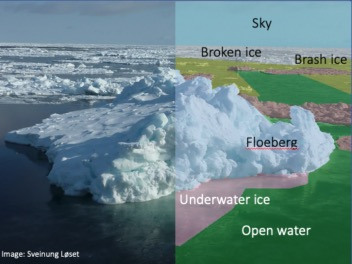
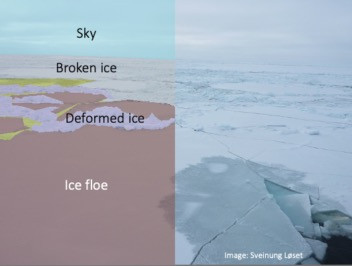
Here are the kinds of ice that Ask Knut is learning to identify:
Iceberg: A large piece of freshwater ice that has broken off a glacier or an ice shelf and is floating freely in open (salt) water.
Deformed ice: A general term for sea ice that has been broken and reoriented. It includes ridged, hummocked, and rafted ice. Deformed ice is distinguished by its high surface roughness.
Level ice: Sea ice that has been unaffected by deformation.
Broken ice: Ice that has been broken into pieces.
Ice floe: A large pack of floating ice often defined as a flat piece at least 20m across at its widest point, and up to more than 10km across
Floe berg: A massive piece of sea ice composed of a hummock or a group of hummocks, frozen together and separated from any ice surroundings. It may float up to 5m above sea level.
Floe bit: A smaller version of floe bergs
Pancake ice: Predominantly circular pieces of ice from 30cm to 3m in diameter, and up to about 10cm in thickness, with raised rims due to the pieces striking against one another. It may be formed on a slight swell from grease ice, shuga, or slush, or as a result of the breaking up of ice rind, nilas, or, under severe conditions of swell or waves, grey ice.
Brash ice: Accumulation of floating ice made up of fragments not more than 2m across (small ice cakes); the wreckage of other forms of ice.
Sources: Glossary of Ice Terminology, Glossary of Ice Terms