
From seawater to drinking water, with the push of a button

Researchers have developed a portable desalination unit, weighing less than 10 kilograms, that can remove particles and salts to generate drinking water.
The suitcase-sized device, developed by Massachusetts Institute of Technology (MIT), automatically generates drinking water that exceeds World Health Organisation quality standards and requires less power to operate than a phone charger. It can also be powered by a small, portable solar panel.
Unlike other portable desalination units that require water to pass through filters, the device is powered by electricity to remove particles from drinking water. Eliminating the need for replacement filters greatly reduces long-term maintenance requirements and could enable the unit to be deployed in remote and severely resource-limited sites, including communities on small islands, refugee encampments and during military operations.
Jongyoon Han, MIT professor of electrical engineering, computer science and biological engineering, said: “This is really the culmination of a 10-year journey that I and my group have been on.
"We worked for years on the physics behind individual desalination processes, but pushing all those advances into a box, building a system, and demonstrating it in the ocean, that was a really meaningful and rewarding experience for me.”
Filter-free technology
Commercially available portable desalination units typically require high-pressure pumps to push water through filters, which are very difficult to miniaturise without compromising the energy-efficiency of the device. Instead, the MIT unit relies on a technique called ion concentration polarisation (ICP), which was pioneered by Han’s group more than 10 years ago.
Rather than filtering water, the ICP process applies an electrical field to membranes placed above and below a channel of water. The membranes repel positively or negatively charged particles — including salt molecules, bacteria, and viruses — as they flow past. The charged particles are funnelled into a second stream of water that is eventually discharged.
"We worked for years on the physics behind individual desalination processes, but pushing all those advances into a box, building a system, and demonstrating it in the ocean, was a really meaningful and rewarding experience."
The process removes both dissolved and suspended solids, allowing clean water to pass through the channel. Since it only requires a low-pressure pump, ICP uses less energy than other techniques.
But ICP does not always remove all the salts floating in the middle of the channel. So the researchers incorporated a second process, known as electrodialysis, to remove remaining salt ions, using machine-learning to find the ideal combination of ICP and electrodialysis modules.
The researchers designed the device for use by non-experts, with just one button to launch the automatic desalination and purification process. The team also created a smartphone app that can control the unit wirelessly and report real-time data on power consumption and water salinity.
Beach tests
After undergoing lab experiments, the device was field-tested at Boston’s Carson Beach. The team set the box near the shore and tossed the feed tube into the water. In about half-an-hour, the device had filled a plastic drinking cup with clear, drinkable water.
“It was successful even in its first run, which was quite exciting and surprising. But I think the main reason we were successful is the accumulation of all these little advances that we made along the way,” Han says.
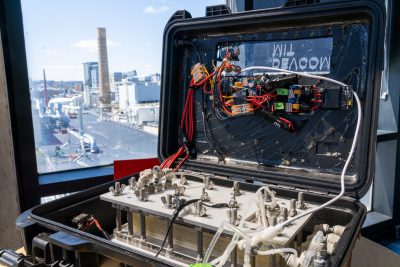
The prototype generates drinking water at a rate of 0.3 litres per hour, and requires only 20 watts of power per litre.
“Right now, we are pushing our research to scale up that production rate,” says research scientist and first author Junghyo Yoon.
In the lab, Professor Han wants to apply the lessons he has learned over the past decade to water-quality issues that go beyond desalination, such as rapidly detecting contaminants in drinking water. The research has been published online in Environmental Science and Technology.