
Geologists reconstruct ice age waterfall at ancient cave
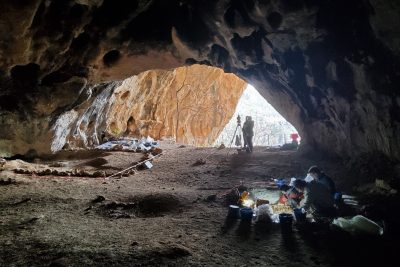
The latest analysis from an archaeological excavation at an ancient cave in north-east Spain suggests that the site featured a "spectacular waterfall" during the ice age.
The Cova del Tabac is in a canyon on the Segre River in the mountainous province of Lleida in Catalonia. It was declared a UNESCO World Heritage Site in 1998 because of its rock art - 12 sketched figures of humans and animals thought to date from the transition from the neolithic period to the Bronze Age, over 6,000 years ago.
Studies by archaeologists and geologists at the site, which houses thousands of stalagmites, along with fossil-bearing sediments, is enabling reconstruction of the region's fauna from a much earlier time. During the Pleistocene - a geological period lasting from about 2.5 million to 12,000 years ago and also known as the Ice Age - the site is thought to have featured a waterfall that was not previously known about.
“The initial results obtained from the cave sediments suggest the presence of a spectacular waterfall, which would have emerged from the cavity and leaped more than 200m into the Segre River canyon bottom."
Geologist Alfonso Benito Calvo from the Consorcio del Centro Nacional de Investigación de La Evolución Humana (CENIEH) in Burgos, Spain, is now leading a team 'reconstructing' the ancient waterfall, in collaboration with archaeologists at the Universitat Autònoma de Barcelona (UAB). The multi-disciplinary analysis will include digital mapping and 3D analysis; electron spin resonance dating; geology; archaeometry; and microscopy.
“The initial results obtained from the cave sediments suggest the presence of a spectacular waterfall, which would have emerged from the cavity and leaped more than 200 metres into the Segre River canyon bottom," said Benito Calvo,
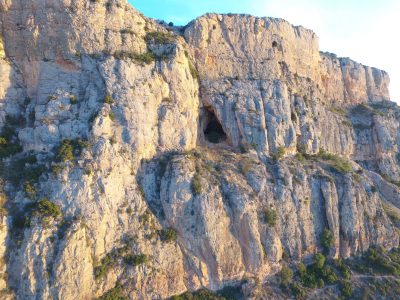
The analyses are being combined with the data gathered in the excavation and the archaeological study directed by the Centre d'Estudis del Patrimoni Arqueològic (CEPArq) at UAB.