
Going back to source - a personal journey
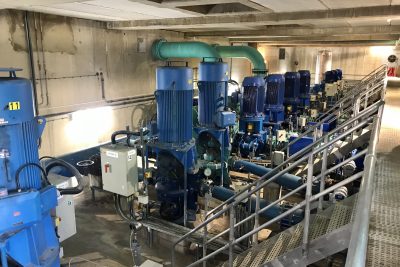
A visit to a water treatment works should be nothing out of the ordinary for Francis Paonessa, after all he works for Thames Water, but on this occasion it was personal.
My visit to Thames Water’s Cleeve water treatment works (WTW) was a bit of an indulgence really, because in addition to it being the UK’s - and at one point Europe’s - largest groundwater-sourced water treatment works, it also happens to be the one that supplies our family home. You can’t really visit the actual source of your gas or electricity, because it is so distributed, so it was a real privilege to be able to see where every drop of water that enters our house comes from.
Despite being only a few hundred metres from the River Thames at Goring, it might be surprising to hear that the source of the water at Cleeve WTW is 11 boreholes, each roughly 100m deep, that draw water from the local underground aquifers. At the bottom of each borehole is a large submersible pump that raises the water to the surface and out of a pipe through a borehole headplate.
Coming from an aquifer, the water is already of high quality, so the only filtration stage is through granular activated carbon which also removes any trace chemicals such as pesticides or fertiliser from domestic or agricultural use which have seeped down into the water table.
"It was a real privilege to be able to see where every drop of water that enters our house comes from."
The next stage is probably the one you most naturally associate with drinking water and that is chlorination to kill any pathogens. We do this by dosing the water in underground contact tanks with sodium hypochlorite, which is much safer to store and handle than liquid chlorine.
We also add orthophosphoric acid, which helps form a protective layer on the inside of the pipes in any properties that still have lead pipes. Now you might be a bit aghast at the thought of acid being added to drinking water, but orthophosphoric acid is much more commonly found in soft drinks at concentrations up to 100 times higher than we use, so it is perfectly safe in water production.
As the water is about to leave the site from the pump room, the final step is the addition of sodium bisulphite, which lowers the chlorine level from that needed to initially disinfect the water to a residual level which keeps it safe as it travels around our network until it reaches our customers' taps. So, yes, we add another unpleasant sounding chemical to your drinking water, but again, it is perfectly safe and more usually found as a rising agent in food production.
Each stage of the water treatment process where we add chemicals is carefully monitored with three completely independent sensors. They sound an alarm in the control room if just one of them goes out of range, to ensure that our customers receive consistently high quality, safe drinking water.
It was a great privilege to visit the site and to meet the hardworking team who ensure that me and my family, along with about half a million other people south of Oxford and to the north-west of Reading, receive around 100 million litres of fresh water on tap, 24 hours a day.
About the author: Dr Francis Paonessa is capital delivery director for Thames Water, the UK's largest water and wastewater company. He has a degree in aeronautical engineering and a PhD in fluid mechanics.