
Stunning shot heralds needle-free vaccines and tattoos
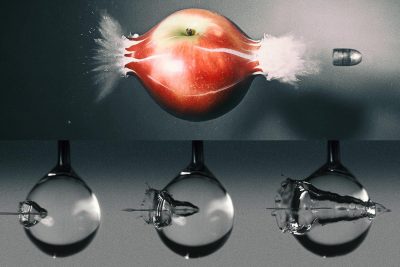
A stunning high-speed image showing a a jet of water squirting through a drop of liquid may sound like photographic fun, but it could help scientists identify ways to inject fluids such as vaccines – and even tattoo ink - through skin without using needles.
That’s the motivation behind a new study by engineers at MIT – Massachusetts Institute of Technology - and the University of Twente in the Netherlands. The research involves firing small jets of water through many kinds of droplets, hundreds of times over, using high-speed cameras to capture the impact of each.
The team’s videos are reminiscent of the famous strobe-light photographs of a bullet piercing an apple, taken by MIT scientist Harold Edgerton in the 1960s. His pioneering sonar and deep-sea photography equipment was used by celebrated film-maker and conservationist Jacques Cousteau.
The team’s new videos, of a water jet fired through a droplet, reveal surprisingly similar impact dynamics. As the droplets in their experiments are transparent, the researchers were also able to track what happens inside a droplet as a jet is fired through.
Based on their experiments, the researchers developed a model that predicts how a fluid jet will impact a droplet of a certain viscosity and elasticity. As human skin is also a viscoelastic material, they say the model may be tuned to predict how fluids could be delivered through the skin without the use of needles.
“We want to explore how needle-free injection can be done in a way that minimises damage to the skin,” says David Fernandez Rivas, a research affiliate at MIT and professor at the University of Twente. “With these experiments, we are getting all this knowledge, to inform how we can create jets with the right velocity and shape to inject into skin.”
Laser jets
In the new study, the team set up a laser-based microfluidic system and fired off thin jets of water at single water droplets hanging from a vertical syringe. They varied the viscosity of each droplet by adding certain additives to make it as thin as water, or thick like honey. They then recorded each experiment with high-speed cameras.
Playing the videos back at 50,000 frames per second, the researchers were able to measure the speed and size of the liquid jet that punctured and sometimes pierced straight through the drop. The experiments revealed interesting phenomena, such as instances when a jet was dragged back into a pendant, due to the pendant’s viscoelasticity. At times the jet also generated air bubbles as it pierced the pendant.
Penetrating pores
“Understanding these phenomena is important because if we are injecting into skin in this way, we want to avoid, say, bringing air bubbles into the body,” Rivas says.
MIT professor Ian Hunter is collaborating with Rivas on a separate needle-free injection system to deliver smaller volumes into shallower layers of the skin, similar to the depths at which tattoos are inked.
“This new method of generating high-velocity microdroplets is very important to the future of needle-free drug delivery,” Hunter says. “An understanding of how these very fast-moving microdroplets interact with stationary liquids of different viscosities is an essential first step to modelling their interaction with a wide range of tissue types.”
The team plans to carry out more experiments, using droplets with properties even more like those of skin. The results from these experiments could help fine-tune the models to narrow in on the optimal conditions for injecting drugs, or even inking tattoos, without using needles.
This research was supported in part by the European Research Council under the European Union Horizon 2020 Research and Innovation Programme.