
Fish tracking project will protect marine habitats

The journeys made by around 1,000 fish in the English Channel have been tracked in an ambitious project to preserve the habitats of some of the region’s key species.
Over the last two years, innovative underwater technology has been used to create a major tracking network to identify the environmental conditions a range of important marine species need in order to thrive. Almost 200 listening devices were placed along the coasts of England, France and Belgium to enable researchers to paint a comprehensive picture of fish movements and the habitats that individual species prefer.
The work was carried out through Fish Intel, a collaborative project led by the University of Plymouth, with partners from UK, France and Belgium, including the Marine Conservation Society. The focus has been on five species – European sea bass, pollack, black bream, bluefin tuna, and crawfish – that play a critical role in the Channel’s fishing industry and ecosystem health.
"The network will mean we can track these species for many years, giving us an unrivalled picture of the habitats they prefer and how we can protect them.”
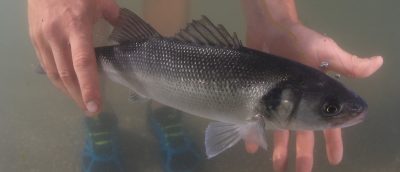
Acoustic tracking devices were attached to crawfish or inserted into fish. They work by pinging a unique code heard by the listening devices placed within different habitats such as estuaries, mussel farms, shipwrecks, reefs and windfarms.
With each tagged fish having a unique signal, the researchers discovered that while some sea bass travel from Devon, on the south coast of England, to Belgium over a number of months, other species such as crawfish stay much closer to home and tend not to stray more than 2km in any particular direction. The findings will help researchers identify specific sites that different species frequent through the year and provide insights that could help establish protected areas, while creating sustainable fishing industries.
Dr Emma Sheehan, associate professor of marine ecology at the University of Plymouth, is the project’s principal investigator. She said: “The Fish Intel project has been an international team effort, bringing together stakeholders from three countries to support the current and future conservation of our fisheries.
“Over the past two years, we have built Europe’s largest multi-species telemetry array which is allowing us to track fish along everything from estuaries to reefs, shipwrecks and coastal structures. It is also enabling us to see how individual species respond to emerging and expanding industries such as offshore renewable energy and aquaculture.
"The network we now have in place will mean we can continue to track these species for many years, giving us an unrivalled picture of the habitats they prefer and how we can protect them now and in the future.”
The listening devices are expected to remain on the seabed for at least five years. Researchers plan to keep monitoring the data so any changes in fish movements over a longer timeframe can also be assessed.
Their ultimate aim is to enable authorities in England, France and Belgium to implement Ecosystem Based Fisheries Management programmes to enhance the condition and water quality in these habitats, as well as helping activities – such as fishing, civil engineering projects and extract industries – to function in a sustainable way.
The €4.1million Fish Intel project is supported by Interreg France (Channel) England Programme, an EU programme set up to foster economic development in the south of the UK and north of France by funding innovative projects which have a sustainable and economic benefit.
Carolyn Reid, Interreg FCE programme manager, said: “The Channel area is home to many fishery-dependent communities, with significant importance for local economies and employment.
"We were impressed by the ambition of Fish Intel in using innovative new technology and bringing together a wide range of cross-border stakeholders, in order to improve the sustainable management of marine resources. As a result, the project is expected to significantly enhance the ecological status of our coastal waters while ensuring they remain commercially sustainable.”