
Now that's a trout pout!

Scientists have discovered fish can recognise themselves in photos - proving self-awareness may be more widespread among marine life than previously thought.
Recognising your own face in a mirror or photo is considered an advanced act of cognitive awareness that is fairly unique to humans and other 'brainy' species such as apes, chimpanzees, dolphins and magpies.
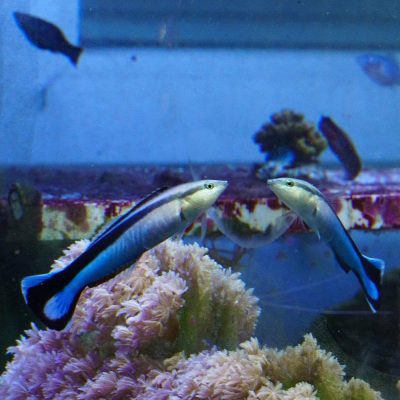
Now a research team, led by Professor Masanori Kohda at Osaka Metropolitan University, has demonstrated that Bluestreak cleaner wrasse fish think “It’s me” when they see themselves in an image.
"This finding suggests that nearly all social vertebrates also have this higher sense of self.”
Kohda and his colleagues came to the conclusion that wrasse can achieve mirror self-recognition by replicating a famous experiment called the 'mark test', in which an artificial mark is placed on the body of an animal while it is anaesthetised.
If the animal inspects the mark on its body in a mirror, or tries to touch or remove it, it suggests that it has identified itself in the reflection, rather than mistaking the mirror image for another individual.
While some mammals and birds have passed the mark test, Kohda and his colleagues were the first to demonstrate fish can achieve this cognitive milestone.
How the experiment worked
The researchers selected the cleaner wrasse specifically because the fish eats parasites off the skin of other animals and so is already attuned to recognising strange marks in its environment. To rule out the possibility the fish thought the photographs were of a different but familiar fish, researchers carried out a photograph version of the 'mark test.'
The fish were presented with a photograph where a parasite-like mark was placed on their throat. Six of the eight individuals that saw the photograph of themselves with a parasite mark were observed trying to rub their throats to clean it off.
In contrast, when they showed those same fish pictures of themselves without parasite marks, or of a familiar cleaner fish with parasite marks, it did not cause them to rub their throats.
Why does this matter?
“This study is the first to demonstrate that fish have an internal sense of self. Since the target animal is a fish, this finding suggests that nearly all social vertebrates also have this higher sense of self,” explained Professor Kohda.
While the thought of a fish being able to recognise itself may seem fairly inconsequential, the implications are rather important for the study of consciousness and self-awareness testing in other non-human animals.
Plus, it highlights the need for us to look after the oceans, rivers, lakes and streams that are home to these animals - after all, they may know - and feel - more than we think.
The findings have been published in the Proceedings of the National Academy of Sciences.