
Highlighting human connections to glaciers

By the end of this century, up to two-thirds of all glaciers worldwide could disappear, scientists say – an alarming scenario that threatens the future of water supply in many places.
Photo-story competition Walk of Water has highlighted disappearing glaciers and the innovative ways water is stored by global communities.
Organised by UNESCO’s World Water Assessment Programme and non-profit social enterprise Onewater, the contest’s theme was Water Towers, to align with the International Year of Glacier Preservation 2025,
More than 7,000 entries were received from photographers and storytellers. Slovenian photographer Ciril Jazbec won first prize for capturing ingenious ice stupas - artificial glaciers built to store water for dry months – in Ladakh, a high-altitude territory in northern India.
“The diversity and creativity of the entries show how deeply people around the world are connected to the resource of water."
Entitled ‘One way to fight climate change: Make your own glaciers’, the submission shows how ice stupas have benefited the community in the village of Gya.
The stupas are constructed by channelling water from higher altitudes through underground pipes. As the water is sprayed into subzero air, it freezes into towering ice formations capable of holding millions of litres of water.
Regional winners included Michele Lapini, whose work highlighted Italy’s thermal-blanket initiative to slow the melting of the Presena Glacier, and Érico Hiller, who documented ice storage practices in northern India.
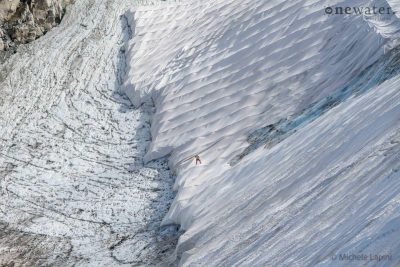
Other submissions featured stunning scenes of an Alpine Lake in South Tyrol, Italy, ice climbers in the Alps, ice hockey on vanishing glaciers in India and polar landscapes, underscoring humanity’s connection to water and the need to protect glaciers – earth's natural water towers.

Michela Miletto, director of UNESCO’s World Water Assessment Programme, said, “The diversity of the entries shows how deeply people around the world are connected to the resource of water.
"They are a wake-up call to the critical importance of protecting glaciers and mountains, our water towers, for the future of humanity.”

A global touring exhibition featuring winning photographers will run throughout 2025. Organisations wanting to host the exhibition can express interest until March 1.

The competition awarded €20,000 in prizes, supported by MPB, the Asian Development Bank, Onewater, and the City of Burghausen.