
Scientists uncover mussels' sticky secret
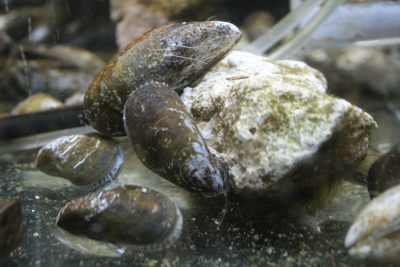
Exactly how blue mussels stay tethered to rocks, even in stormy seas has puzzled scientists for decades.
The molluscs are buffeted by crashing waves day after day, but stay in place thanks to a highly effective glue they produce. Making glue stick where water is present is especially challenging, so scientists interested in producing adhesives for use in wet environments have turned to the molluscs for inspiration.
Mussels’ beards are made up of byssal threads and are used to help keep them tethered in place. At the end of each thread is a disc-shaped plaque that acts as an underwater glue. The unusual qualities of the glue and the byssal threads have interested people since ancient times, when the threads of certain species were woven into luxurious berets, purses, gloves, and stockings.
More recently, scientists have developed underwater adhesives and surgical glues inspired by byssal thread chemistry and at last the cellular mechanisms by which mussels produce their effective underwater adhesive have been uncovered by a team of researchers led by McGill University in Canada. The identification of the mechanisms involved in creating the glue should advance work in this field.
“The specific mechanism by which mussels produce their adhesive has been shrouded in mystery until now because everything occurs hidden from view inside the mussel foot,” says Tobias Priemel, who has been working on this research for the past seven years. “To understand the mechanisms involved we applied advanced spectroscopic and microscopic techniques and developed an experimental approach that combined several advanced and basic methodologies from across biochemistry, chemistry, and materials science."
By gathering information at a subcellular level, the researchers discovered that within the mussel foot, there are micron-sized channels, some just one-tenth the width of a human hair, which funnel the substances that come together to make the glue. Condensed fluid proteins in tiny sacs are secreted into the channels where they mix with metal ions taken up from seawater. The ions are slowly released in a carefully timed process, eventually hardening the fluid protein into a solid glue.
“Mussels can make their underwater adhesive within two to three minutes by mixing metal ions with the fluid proteins,” explains Matthew Harrington, an associate professor in McGill’s chemistry department. “It’s a matter of bringing together the right ingredients, under the right conditions using the right timing. The more we understand about the process, the better engineers will later be able to adapt these concepts for manufacturing bio-inspired materials.”