Solar will help power Scottish wastewater works

Anyone who thinks Scotland is not sunny enough for solar power can think again with panels and battery storage being installed at scale at a Scottish wastewater treatment works.
The solar array, which is Scottish Water's largest to date, will reduce the plant's carbon footprint by around 160 tonnes of CO2 per annum – the equivalent of offsetting carbon from nearly a million kilometres in the average passenger car. The public utility says the large-scale battery storage project in the city of Perth will accelerate its drive towards net zero emissions by 2040.
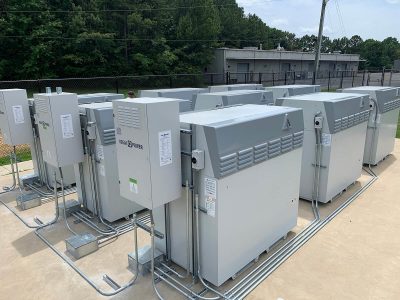
The scheme, delivered by Absolute Solar & Wind, is part of a £2 million renewables project which has already seen four vanadium flow batteries from Invinity Energy Systems installed. The batteries can store up to 0.8MWh of energy and will be used to store power generated from more than 2,520 solar panels, with a combined output of over 1 MW.
By enabling solar energy to be used at any time of the day or night, the battery system will allow around 94% of the renewable power generated to be used on site – a significant step forward in the company’s decarbonisation ambitions. The scheme will also help to power the utility’s first rapid electric vehicle charging points which have been installed at the site; and will reduce energy costs of the treatment works by approximately 40 per cent.
This installation is the latest investment by Scottish Water Horizons, the utility’s commercial subsidiary, which is developing a programme of opportunities for battery storage across Scottish Water’s assets.
Scottish Water Horizons business development manager, Donald MacBrayne, said: “We’re excited to have our first battery facility up and running to help reduce emissions and tackle climate change. The ability to maximise green energy production as well as store and release this energy when we need it is a vital part of our journey to net zero.
"By harnessing this technology, we now have a much wider opportunity to install renewables schemes that were previously unviable due to grid constraints. It’s a massive sep forward for us and will form an integral part of how we cut our emissions in the coming years.
"It’s fantastic news for the customers in Perth as they can now benefit from a treatment service with a significantly lower carbon footprint, helping them with their ambition to become the most sustainable small city in Europe.”
"The ability to maximise green energy production as well as store and release this energy when we need it is a vital part of our journey to net zero."
The utility-grade vanadium flow batteries were assembled by Invinity Energy Systems at their manufacturing and assembly facility in West Lothian. Invinity’s patented vanadium flow battery technology is proven to be a safer, more durable and sustainable alternative to traditional lithium-ion batteries.
Matt Harper, chief commercial officer at Invinity Energy Systems, said, “Utility-grade energy storage, such as our vanadium flow batteries, has a key role to play in unlocking the low-cost, low-carbon energy we require to reach net zero, while helping to shield companies from rising commercial energy prices.”
David Hill, chief commercial officer, Open Energi said: “The use of vanadium flow storage enables Scottish Water to soak up a greater proportion of their onsite solar generation when compared to conventional lithium-ion storage. Our micro-grid optimisation tool, which uses highly localised solar, demand and wholesale energy price forecasting capabilities, ensures not a single drop of sun’s energy is wasted."
Scottish Water has committed to reach net zero carbon emissions by 2040 with an interim target to host or self-generate three times its annual electricity consumption by 2030. Almost 80 of the utility’s water and wastewater treatment works are now either self-sufficient or partly sufficient in their power requirements.