Tap water shields against kettle microplastics
Scientists investigating the release of microplastics from kitchen kettles have shown that tap water can produce a protective shield against potentially harmful chemicals.
Microplastics can carry a range of contaminants such as trace metals and some potentially harmful organic chemicals.The research published in the Chemical Engineering Journal reveals that tap water contains trace elements and minerals, which prevent plastics from degrading in the water and releasing microplastics.
Previous studies investigating release of microplastics have used forms of pure water which only exist in laboratories, and do not take into account the ions and impurities found in tap water.
Professor John Boland from Science Foundation Ireland’s Centre for Advanced Materials & Bioengineering Research (AMBER) and the School of Chemistry at Trinity, who was a co-leader of the research team, said: “It is well known that plastics can degrade and release microplastics, which can get into the environment and be consumed by humans.
"Our research shows that many items such as plastic kettles, which are repeatedly used with tap water, can develop over time a protective skin that prevents the release of microplastics entirely. Because tap water is not 100% pure H2O – since it contains trace elements and minerals, what we showed is that if you include these trace elements and minerals the degradation of plastics in tap water is completely different.
"Rather than the plastics falling apart, the minerals coat the plastic and prevent any kind of degradation and so the product becomes microplastic-free. For example, that dark brown colour in your kettle is a good thing. It is copper oxide that forms from copper minerals in your tap water, which in turn comes from the copper pipes in your house – all these combine to give a perfect protection to the kettle.
“This discovery is important because we have learned that these types of protective skins can be manufactured in the laboratory and directly applied to the plastic without having to wait for it to build up naturally. This discovery also shows that nature is leading the way, pointing to solutions to what is a very significant problem facing our modern high-tech society.”
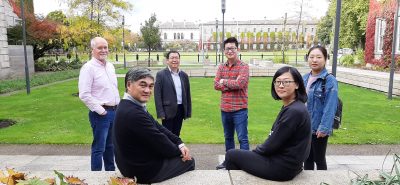
The team of scientists from Trinity College and University College Dublin was led by Professor Boland and Dr Jing Jing Wang from AMBER and Trinity’s School of Chemistry, with Professor Liwen Xiao from Trinity Haus and School of Engineering.
The research team was supported by Enterprise Ireland, Science Foundation Ireland, the School of Engineering Scholarship at Trinity, the China Scholarship Council and the Irish Research Council.
"Nature is leading the way,"