
Unexpected life discovered deep below ice shelves
Far beneath the ice shelves of the Antarctic lurks a secret world of thriving marine life.
Despite occupying nearly 1.6 million km2, ice shelves are some of the least known environments on Earth. While life has been captured on camera in these dark, cold habitats it has rarely been collected for scientific study.
Enter a team of researchers from the Alfred Wegener Institute (AWI), Helmholtz Centre for Polar & Marine Research in Germany, who drilled holes through nearly 200 metres of the Ekström Ice Shelf near Neumayer Station III in the South Eastern Weddell Sea in 2018.
Despite the environment being harsh and cold (minus 2.2 degrees centigrade) they found unexpected life on the seabed floor - discovering an incredible 77 species including sabre shaped bryozoans (moss animals) such as Melicerita obliqua and serpulid worms including Paralaeospira sicula.
Despite being several kilometres from the open sea, the researchers found the biodiversity of the specimens they collected was even richer than in than many open water samples found on the continental shelf, where there are light and food sources.
"The big question is how do these animals survive and flourish here?”
The team's results were published in the journal Current Biology, in December 2021.
“This discovery of so much life living in these extreme conditions is a complete surprise and reminds us how Antarctic marine life is so unique and special," said lead author Dr David Barnes, a marine biologist at British Antarctic Survey.
"It’s amazing that we found evidence of so many animal types, most feed on micro-algae (phytoplankton) yet no plants or algae can live in this environment. So the big question is how do these animals survive and flourish here?”
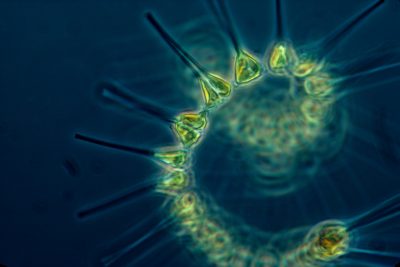
The team concluded there must be enough algae carried under the ice shelf from open water to fuel a strong food web. Microscopy of samples showed that, surprisingly, annual growth of four of the species was comparable with similar animals in open marine Antarctic shelf habitats.
“Another surprise was to find out how long life has existed here. Carbon dating of dead fragments of these seafloor animals varied from current to 5,800 years," said co-author Dr Gerhard Kuhn (AWI). "So, despite living 3-9 km from the nearest open water, an oasis of life may have existed continuously for nearly 6,000 years under the ice shelf. Only samples from the seafloor beneath the floating ice shelf will tell us stories from its past history.”
The team stressed that with climate change leading to the collapse of ice shelves, time is running out to study and protect these ecosystems.