
Why are icicles rippled?

Whenever the temperature next drops below zero, and icicles appear, look carefully and you will see that they show a ripple pattern – always around one centimetre wide.
What causes these ripples? Using an icicle machine of their own design, physicists and chemists from the University of Amsterdam investigated this question, and discovered that salt plays an important part in the formation of the ripples.
The research was carried out by PhD student Menno Demmenie and his colleagues who built an icicle machine using a large freezer with a window.
"We spent a few weeks becoming true icicle growth specialists," Demmenie recalls. "The difficult question was how fast water must be added to make a nice icicle.
"If the water flows too quickly, one loses a relatively large amount of water, turning the floor of the freezer into a sheet of ice. On the other hand, if the flow of water is dialled down too much, the icicle tends to grow upward, like a stalagmite.
"Eventually we discovered that the optimal rate of growth occurs using an inflow of 60mm per hour, at a temperature of -15°C. This is comparable to a faucet dripping roughly once every three seconds."
Once the correct inflow of water was found, the researchers could proceed. Using their machine they made many different icicles, under different circumstances and with different types of water.
In the end, the crucial factor in the formation of icicle ripples turned out to be the concentration of salt in the water that was used. With the increase of the concentration of salt, the ripples on the icicles became more clearly visible.
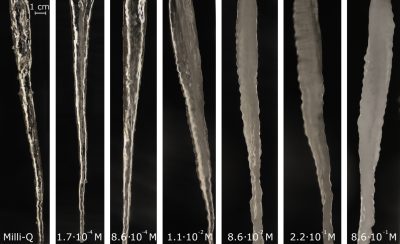
The researchers used a clever trick to investigate the role that salt plays in the formation of icicles. When the water forming an icicle freezes, salt molecules get pushed out of the ice as impurities.
As a result, most of the salt is found in a thin layer of liquid water on the surface of the icicle. The scientists added a colouring agent to the liquid water, which underwent the same process as the salt molecules, allowing them to visualise where the liquid salty water was present.
Ripples explained
It was discovered that the flow of liquid water caused the ripples to appear. Using pure water, the layer of salty liquid water around the icicle was absent, and the formation process looked more like a dripping candle.
When saltier water was used, the icicle was surrounded by a thin film of liquid, salty water, and the flow of that water created the regular ripples. The more salt the water contained, the stronger the process, causing thicker ripples to eventually form.

In nature, water always contains a small concentration of salt. This explains the beautiful structures we find on our gutters and car bumpers in the morning – rippled by a thin layer of slightly salty water that was at work throughout the night.
The research was carried out by researchers from the Institute of Physics and the Van ’t Hoff Institute for Molecular Sciences at the University of Amsterdam. The results were published in the scientific journal Physical Review Applied.